Understanding Lower Back Pain: Why It Steals More Than Comfort
Lower back pain doesn’t just limit movement it quietly erodes confidence, stability, and trust in your own body.When the spine feels unsafe, the mind follows, creating hesitation in everyday actions.Reclaiming ease begins with understanding how pain changes your posture, breath, and behaviour.
The Hidden Patterns Behind Persistent Back Pain
Pain often emerges from long‑held movement habits, not sudden injury.Small compensations accumulate until the body can no longer adapt.Awareness of these patterns is the first step toward restoring natural balance.
How Back Pain Disrupts Your Sense of Safety and Confidence
When movement feels unpredictable, the nervous system shifts into protection mode.This protective tension reduces mobility and increases fear of further pain.Confidence returns when the body learns to move without bracing or guarding.
Gentle Mindful Movement: The Path Back to Ease
Slow, mindful movement retrains the body to release unnecessary tension.Each small, safe action signals to the nervous system that it can relax.Consistency builds trust, and trust rebuilds confidence from the inside out.
There’s a moment in life, usually somewhere after fifty, when you realise your lower back has quietly become the centre of every decision you make. You think about it when you get out of bed. You think about it when you reach for the kettle. You think about it when you drop something on the floor and pause, wondering whether picking it up is worth the risk.
Lower back pain isn’t dramatic. It doesn’t shout. It just slowly steals confidence, one hesitant movement at a time.
Most people assume the pain is caused by age, or wear and tear, or “just how it is now.” But the truth is simpler: the body loses its natural balance long before it loses its strength. The spine becomes a little less responsive. The pelvis no longer glides the way it used to. The ribs don’t rotate as freely. And suddenly, the lower back is doing jobs it was never designed to do.
Dennis Bartram’s work has always centred on this idea: pain is rarely the problem – it’s the signal. The body is telling you something about how you’re moving, how you’re standing, how you’re compensating. And the beautiful thing is that the body also knows how to correct itself when you give it the right conditions.
Lower back pain becomes less frightening when you understand it. When you see it not as a failure, but as feedback. And when you learn to move with awareness again, the back often softens, loosens, and begins to trust you the way it once did.
2. Stiff Neck / Tech Neck The Weight of Modern Life
A stiff neck is one of those pains that sneaks up on you. One day you’re fine, and the next you’re turning your whole body just to look over your shoulder. For many over‑50s, this isn’t just discomfort; it’s a reminder of how much the world has changed.
We weren’t designed to live with our heads tilted forward, staring at screens, reading small text, or holding tension in the shoulders for hours at a time. The neck is a delicate balance of tiny muscles, vertebrae, and nerves, and when that balance is lost, everything tightens to protect you.
Dennis’s approach to neck pain is beautifully simple: the neck is never the culprit – it’s the messenger. When the ribs stop moving, the neck stiffens. When the pelvis locks, the neck compensates. When breathing becomes shallow, the neck takes over the work.
This is why rubbing the neck rarely solves anything. The real change happens when you restore movement lower down, when the spine begins to ripple again, when the ribs rotate, when the pelvis finds its natural rhythm. The neck relaxes because it no longer has to hold the world up on its own.
For many boomers, this is a revelation. The pain isn’t a sign of decline; it’s a sign that the body is asking for a different conversation.
3. Hip Tightness – The Gatekeeper of Movement
If the lower back is the quiet thief, the hips are the gatekeepers. When they tighten, everything else tightens with them. Walking becomes stiff. Sitting becomes uncomfortable. Getting in and out of the car becomes a negotiation.
Hip tightness is one of the most common complaints for people over fifty, and yet it’s also one of the most misunderstood. Most people assume their hips are “weak” or “worn out,” but in reality, the hips are often overworking, not underperforming.
The hips tighten when the spine stops sharing the load. They tighten when the feet stop communicating with the ground. They tighten when the ribs stop rotating. They tighten when balance becomes uncertain.
Dennis’s work shows that the hips are not isolated joints; they are part of a whole‑body conversation. When you restore natural balance, the hips soften. When you reconnect the spine, the hips glide. When you breathe fully, the hips release.
And when the hips move freely again, something remarkable happens:
There’s a moment many people don’t talk about, the moment they realise getting down to the floor has become a conscious decision rather than a natural movement. It’s not fear of the floor itself. It’s the fear of what happens next: Will I get back up? Will something catch? Will something give way?
This fear isn’t weakness. It’s wisdom. The body remembers every time it felt unstable, every time balance wobbled, every time a joint didn’t respond the way it used to.
But here’s the truth:
The ability to get down to the floor is one of the strongest indicators of long‑term mobility.
Not because it’s athletic, but because it requires coordination, balance, confidence, and trust in your own body.
Dennis’s approach to floor movement is gentle and deeply human. He teaches that the floor isn’t an enemy, it’s a teacher. It shows you where your balance is, where your breath is, where your confidence is hiding.
When you learn to move toward the floor with awareness rather than force, the body begins to remember. The spine softens. The hips release. The knees stop bracing. And the fear slowly fades. Getting down to the floor isn’t about fitness. It’s about reclaiming a part of yourself you thought was gone.
5. Knee Pain Going Upstairs: The Hidden Story of Load and Alignment
Knee pain is one of those things people shrug off as “just age,” but it’s rarely about the knee itself. The knee is a hinge, a beautifully simple joint and like any hinge, it only struggles when the structures above and below it stop doing their share.
For many over‑50s, the first sign of trouble is climbing stairs. That little pinch. That hesitation. That moment when the knee feels like it’s carrying the whole world. But the truth is, the knee is often compensating for a pelvis that isn’t gliding, a foot that isn’t grounding, or a spine that isn’t rotating.
Dennis’s work shows that knee pain is almost always a balance problem, not a knee problem. When the pelvis moves freely, the knee tracks naturally. When the foot communicates with the floor, the knee stabilises. When the ribs rotate, the knee stops bracing.
The knee doesn’t need strengthening; it needs cooperation.
And when the whole body begins to share the load again, the knee often sighs with relief.
6. Shoulder Pain – Frozen Shoulder The Armour We Didn’t Know We Were Wearing
Shoulder pain is deeply emotional. It’s where we hold tension, responsibility, and the weight of things we never quite said out loud. For many boomers, shoulder stiffness isn’t just physical; it’s a lifetime of bracing.
The shoulder is a floating joint, designed to move with the ribs, the spine, and the breath. But when life becomes stressful, the shoulders rise. When breathing becomes shallow, the shoulders tighten. When balance is uncertain, the shoulders guard.
Frozen shoulder, in particular, is often misunderstood. People think the shoulder is “stuck,” but Dennis teaches that it’s protecting, not failing. It’s guarding because something else isn’t moving the way it should.
When you restore rib rotation, the shoulder softens.
When you reconnect the spine, the shoulder frees.
When you breathe fully, the shoulder trust again.
The shoulder doesn’t need forcing; it needs permission.
7. Sciatica When the Body Sends a Clear Message
Sciatica is one of those pains that gets your attention immediately. Sharp, electric, unpredictable. It can make even the simplest movement feel like a negotiation.
But sciatica is rarely about the nerve itself. It’s about the pathway the nerve travels through the pelvis, the hips and the deep stabilising muscles. When those structures tighten or shift out of balance, the nerve becomes irritated.
Dennis’s approach is refreshingly simple:
Free the movement, and the nerve stops complaining.
When the pelvis finds its natural rhythm, the pressure eases.
When the hips glide instead of grip, the pathway opens.
When the spine rotates, the nerve is no longer pinched between competing tensions.
Sciatica isn’t a sign of damage; it’s a sign of imbalance.
8. Foot Pain / Plantar Fasciitis – The Forgotten Foundation
Most people don’t think about their feet until they hurt. But the feet are the foundation of everything: balance, posture, movement, confidence. When the feet stop communicating with the ground, the whole body pays the price.
Plantar fasciitis, arch pain and heel pain are often signs that the feet have lost their natural spring. Not because they’re weak, but because the rest of the body has stopped supporting them.
Dennis teaches that the feet are not passive structures; they are sensory organs. They read the floor. They guide the hips. They stabilise the spine. When the feet wake up, the whole body wakes up.
Foot pain is rarely a foot problem.
It’s a whole‑body conversation waiting to happen.
9. Balance Loss When Bending – The Body’s Early Warning System
Losing balance when bending isn’t clumsiness; it’s communication. The body is telling you that the relationship between your head, spine, and pelvis needs attention.
For many over‑50s, this is the first sign that confidence is slipping. Not because the body is failing, but because the body is adapting. It’s bracing. It’s protecting. It’s doing its best with the information it has.
Dennis’s work shows that balance isn’t a skill; it’s a state of awareness. When the spine moves freely, balance returns. When the ribs rotate, balance stabilises. When the pelvis glides, balance becomes effortless again.
10. Difficulty Getting Back Up From the Floor – The Real Test of Mobility
Getting down to the floor is one thing. Getting back up is another. For many people, this is the moment they realise their body has been quietly negotiating behind the scenes.
But here’s the truth:
Getting up from the floor is not about strength – it’s about sequencing.
When the spine coils, the body rises.
When the hips release, the body lifts.
When the feet ground, the body trusts.
Dennis’s approach is gentle: teach the body the sequence again, and it remembers.
You see confidence in the way your posture naturally lifts.
“If Your Body Could Feel Easier Tomorrow… Would You Take the First Step Today?”
Most people don’t want a workout plan; they want their body to feel lighter, calmer, and more reliable again. If today’s video helped you notice even a small shift in how you breathe or move, the Mobility Reset Method takes that feeling further.
It’s a gentle, step‑by‑step approach designed to help you:
Release stiffness without forcing anything.
Move with more confidence and less hesitation.
Breathe easier and feel more “in your body”
Reconnect with natural movement you thought you’d lost.
If you’re ready for a simple way to feel better in your own skin, you can explore it here:
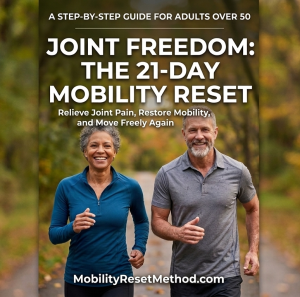
Mobility Reset Method: Reversing Chronic Joint Pain in 21 Days at Home




 If the lower back is the quiet thief, the hips are the gatekeepers. When they tighten, everything else tightens with them. Walking becomes stiff. Sitting becomes uncomfortable. Getting in and out of the car becomes a negotiation.
 Explore more on this topic: