

Natural Movement Pain Relief Restores Balance… How
Why Natural Movement Pain Relief Improves Posture
Discover How Natural Movement and the Nervous System Harmonise
Then Your Body Takes Shape With Pain-Free Movement Within Posture And Poise
 Most people think pain starts where it hurts.
A sore lower back must be a back problem.
A stiff neck must be a neck problem.
A stiff neck must be a neck problem.
Poor balance must mean weak legs.
That belief is understandable, but it’s incomplete.
The body does not organise itself from muscles first.
It organises itself through movement patterns, reflexes, and the nervous system’s relationship with gravity.
It organises itself through movement patterns, reflexes, and the nervous system’s relationship with gravity.
Why balance, gait, and reflexes matter more than muscles alone
When those systems are organised, the body moves easily.
When they are disrupted, pain appears as a warning signal, not as the root cause.
When they are disrupted, pain appears as a warning signal, not as the root cause.
This post explores how natural movement, gait, and neurological reflexes quietly shape posture, balance, and long-term comfort, and why addressing these foundations changes everything.
Pain Is Often a Consequence, not a cause.
Natural Movement Pain Relief Pain is information.
It tells you that something in the system is not working efficiently.
But it rarely tells you where the original problem began.
But it rarely tells you where the original problem began.
For many people, pain develops gradually as the body adapts to:
- prolonged sitting
- repetitive habits
- asymmetrical use of the body
- Reduced movement variety
Over time, these adaptations become normalised. The nervous system learns to move around restrictions rather than resolving them.
The result is a body that still functions, but at a higher cost.
Pain appears when that cost becomes too great.
Reflexes and Predictable Movement Patterns
The human body runs on reflexes.
Some are primitive and automatic. Others are layered, complex, and developed through movement experience over a lifetime.
Walking, reaching, turning, balancing, and reacting are not conscious decisions. They are orchestrated through predictable neurological pathways.
When movement flows freely in all directions, these pathways stay organised.
When injury, habit, or restriction interrupts that flow, the nervous system adapts. It reroutes signals, reduces movement options, and increases protective tension.
This adaptation is clever.
It keeps you upright.
But it is not efficient.
It keeps you upright.
But it is not efficient.
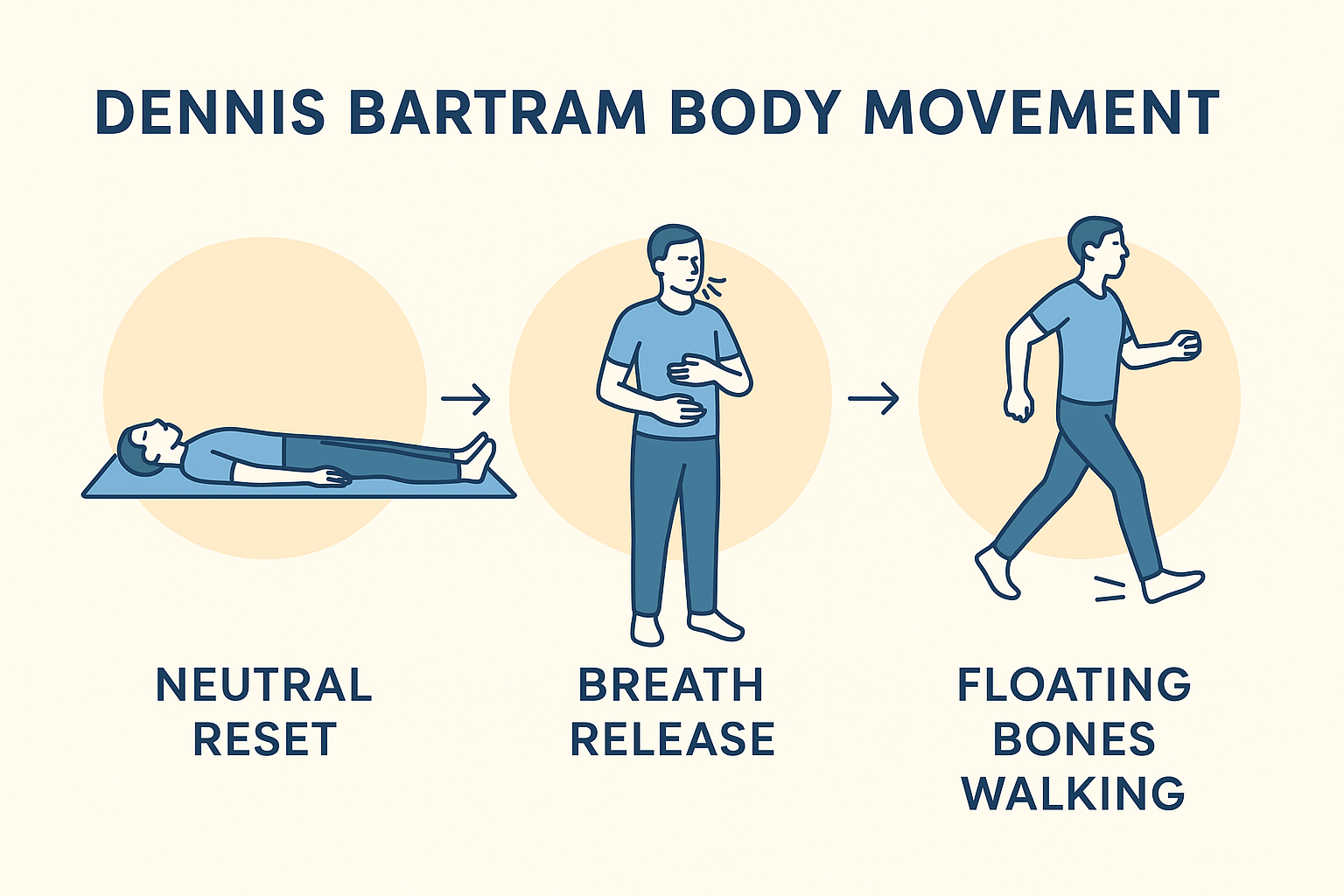
Cross-Pattern Gait: The Foundation of Human Movement
Why natural movement pain relief starts with reflexes
One of the most important movement patterns in the body is cross-pattern gait.
This is the natural coordination of the opposite arm and leg during walking. It links the left and right sides of the brain and integrates the body in three dimensions.
Healthy cross-pattern gait:
- Distributes load evenly
- reduces joint strain
- supports balance and orientation
- keeps movement fluid
When cross-patterning is disrupted, the body compensates by relying more heavily on one side, one joint, or one movement strategy.
Over time, this shows up as:
- Recurring back pain
- hip or knee strain
- shoulder tension
- balance hesitation
The Natural Movement Pain Relief problem is not a strength.
It is an organisation.
Habit Shapes Natural Movement Pain Relief Neurology
Your daily habits quietly sculpt your nervous system.
How long do you sit?
Which hand do you use for your mouse or phone?
Where your screen sits relative to your eyes.
How often do you walk, turn, or change direction?
Which hand do you use for your mouse or phone?
Where your screen sits relative to your eyes.
How often do you walk, turn, or change direction?
All of these inputs create neurological plasticity.
The nervous system adapts to what you do most often. If your movement is repetitive and one-sided, the system narrows its options. Some pathways become dominant. Others fade.
This is why two people with similar pain can have very different underlying causes.
The body always adapts to usage.
Why Muscle Testing Is About Neurology, Not Strength
How natural movement pain relief improves gait timing
When practitioners test muscles in this context, they are not testing muscle power.
They are testing whether a muscle is:
- Properly connected to its neurological pathway.
- receiving clear, organised signals
- participating correctly in movement
A muscle can be strong yet dysfunctional if the signal that feeds it is noisy or inconsistent.
Muscle testing before and after specific challenges reveals whether the nervous system is organised through that pathway or compensating around it.
This is how hidden issues surface, not by guessing, but by observing how the system responds.
When Movement Interruptions Accumulate
An injury interrupts movement flow.
At first, the body compensates.
Later, the compensation becomes the pattern.
Later, the compensation becomes the pattern.
A back strain may heal, but the altered movement remains.
A twisted ankle recovers, but the gait adapts around it.
A fall is “got away with”, but the nervous system remembers.
A twisted ankle recovers, but the gait adapts around it.
A fall is “got away with”, but the nervous system remembers.
Eventually, these adaptations accumulate.
Pain then appears not because something suddenly broke, but because the system has been working inefficiently for too long.
The Nervous System and Natural Movement Pain Relief “Noise” “When movement is unorganised, the nervous system becomes noisy.
This noise is not sound.
It is conflicting or excessive sensory information.
It is conflicting or excessive sensory information.
Joints, fascia, and muscles send signals to the brain about position, load, and movement. When those signals are inconsistent, the brain increases protective output.
That protection shows up as:
- muscle tightness
- reduced movement range
- slower reactions
- guarded posture
The muscle is not the problem.
It is responding to noise upstream.
It is responding to noise upstream.
Why Fixes Often Don’t Last
Many treatments reduce symptoms effectively.
They restore joint range.
They ease muscle tension.
They improve comfort.
They ease muscle tension.
They improve comfort.
But if the underlying movement pattern and neurological organisation remain unchanged, the body slowly returns to its previous strategy.
This is why relief can last weeks or months, but not permanently.
Without re-establishing organised movement, the nervous system defaults back to what it knows.
Natural Movement Pain Relief In Three Dimensions
When natural movement pain relief reduces daily strain
Real walking is not linear.
It involves:
- rotation
- side-to-side transfer
- pitch, roll, and yaw
Most people walk with reduced three-dimensional movement. They move forward but limit rotation and lateral shift.
This creates strain.
In traditional movement systems, walking was understood as a multi-directional movement. Different ways of stepping, turning, and shifting load kept the nervous system adaptable.
Modern life flattens movement into straight lines.
The body adapts, but at a cost.
Floating Versus Holding
When movement is organised, walking feels light.
You don’t push yourself through space.
You move with it.
You move with it.
This is often described as “floating” rather than holding.
Holding requires effort.
Floating requires organisation.
Floating requires organisation.
The difference is neurological, not muscular.
Protection Becomes the New Normal
When you slip on ice, the body reacts instantly.
Reflexes fire.
Muscles tighten.
You return upright.
Muscles tighten.
You return upright.
If the nervous system doesn’t fully reset afterwards, part of that protective tension remains.
Pain may fade, but the spasm stays.
That spasm then becomes part of your normal movement.
Every step aggravates it slightly.
Noise accumulates again.
Every step aggravates it slightly.
Noise accumulates again.
This is how temporary events create long-term patterns.
Why Balance Problems Are Timing Problems
Most balance issues are not caused by weakness.
They are caused by delayed or distorted timing.
The nervous system reacts late because information is unclear.
The body compensates by stiffening.
Movement becomes cautious.
The body compensates by stiffening.
Movement becomes cautious.
When timing improves, balance improves automatically.
The Goal Is Not Correction, but Re-Organisation
The body does not need forcing.
It needs clarity.
When movement pathways are re-established and reflexes are organised, the system corrects itself.
Muscles relax because they no longer need to protect.
Joints move freely because load is shared.
Posture improves because effort reduces.
Joints move freely because load is shared.
Posture improves because effort reduces.
This is not a technique.
It is a principle.
It is a principle.
What This Means for Pain and Posture
Pain is rarely the enemy.
It is the messenger.
When you address the neurological organisation underlying movement, pain often resolves without being directly chased.
Posture improves not because you try to stand straighter, but because the body no longer needs to brace.
Setting the Stage for Daily Natural Movement Pain Relief Support
Understanding these principles matters because lasting change does not come from occasional intervention alone.
It comes from consistent, gentle support that reinforces organised movement and reduces neurological noise.
That is where daily alignment practices and supportive tools come into play.
Not by fixing you,
but by helping your nervous system remember how to organise itself.
but by helping your nervous system remember how to organise itself.
How Subtle Alignment and Daily Support Help the Nervous System Reorganise
Why small, consistent input restores balance, reduces pain, and rebuilds confidence
In this first part, we explored why pain and posture problems are rarely isolated to a single muscle. We looked at how movement patterns, reflexes, and nervous system organisation shape the way the body adapts over time.
Now we turn to the practical question most people are really asking:
What helps the body reorganise itself, and how do you keep it that way?
The answer is not force, intensity, or more correction.
It is a consistent, low-noise input that allows the nervous system to recalibrate.
It is a consistent, low-noise input that allows the nervous system to recalibrate.
The Nervous System Responds to Information, Not Effort
The nervous system is constantly asking one question:
“Is this safe and efficient?”
It answers that question by gathering information from:
- joints
- fascia
- muscles
- balance organs
- pressure through the feet and spine
When information is clear and consistent, the system relaxes.
When information is noisy or conflicting, the system tightens.
When information is noisy or conflicting, the system tightens.
Most chronic pain and balance problems sit in that second category.
The body is not weak.
It is uncertain.
It is uncertain.
Why Subtle Joint Movement Matters
Large movements attract attention, but small joint movements carry some of the most important neurological information.
Subtle motion at the feet, pelvis, spine, and hips tells the brain:
- How is the load being shared
- Whether movement is smooth or interrupted
- Where the body is in space
When these small motions are restricted or distorted, the nervous system fills in the gaps with protection.
This protection is what you experience as stiffness, guarding, or recurring pain.
Restoring subtle movement clarity is often more important than increasing range or strength.
Finding and Reducing “Nuisance Traffic”
Why natural movement pain relief starts with reflexes
Not all sensory information is helpful.
Some signals are what could be called nuisance traffic. They are unnecessary, confusing, or outdated messages still circulating in the system.
These signals often come from:
- old injuries
- adapted joints
- habitual postures
- areas that never fully reintegrated after stress
When nuisance traffic reaches the brain, it interferes with the organisation of clean movement.
The nervous system reacts by tightening elsewhere to compensate.
This is why pain often appears away from the source.
Why the Feet Play Such a Natural Movement Pain Relief Central Role
The feet are among the body’s main hubs for sensory input.
Every step sends information upward about:
- pressure
- direction
- timing
- balance
If this information is distorted, the rest of the system adapts.
The subtalar joint, located beneath the ankle, plays a particularly important role. It allows the foot to adapt to uneven surfaces and transfer movement information into the pelvis and spine.
When this joint becomes restricted or noisy, gait changes.
When gait changes, load distribution changes.
When load distribution changes, pain appears elsewhere.
When gait changes, load distribution changes.
When load distribution changes, pain appears elsewhere.
Many back and hip issues quietly begin here.
Gait Is a Neurological Pattern, Not a Mechanical One
How natural movement pain relief improves gait timing
Walking is not just legs moving forward.
It is a whole-body neurological event involving:
- the feet
- the pelvis
- the spine
- the eyes
- the balance system
When gait is organised, movement feels light and responsive.
When it is disorganised, effort increases and reactions slow.
When it is disorganised, effort increases and reactions slow.
This is why correcting gait mechanically rarely holds.
Without neurological re-organisation, the body defaults back to familiar patterns.
Without neurological re-organisation, the body defaults back to familiar patterns.
How the Nervous System Learns Through Repetition
The nervous system learns best through Natural Movement. Pain Relief :
- repetition
- consistency
- low threat
This is why subtle, repeated input works better than occasional intense correction.
Daily alignment support provides the system with a reliable reference point. Over time, the brain recognises this input as safe and begins to reorganise around it.
This process is gradual but stable.
Nothing is forced.
Nothing is overridden.
Nothing is overridden.
The body learns again.
Why Force Creates Resistance
Strong interventions can create temporary change, but they often trigger protective reflexes.
The nervous system may comply briefly, but it does not integrate the change.
Once the stimulus is removed, the system reverts.
Gentle alignment works differently. It stays below the threshold of resistance. This allows information to be absorbed rather than defended against.
Think of it as a conversation rather than a command.
The Role of Daily Alignment Support
When natural movement provides pain relief, it reduces body strain
Daily alignment support works because it:
- Reduces background noise
- clarifies joint position
- supports symmetrical loading
- reinforces organised movement
This consistency is what the nervous system responds to.
Over days and weeks, people often notice:
- Less effort when standing,
- smoother transitions when walking,
- reduced end-of-day fatigue,
- improved confidence in balance,
These changes arrive quietly.
They are felt before they are noticed.
They are felt before they are noticed.
Why Balance Improves Without Balance Training
Balance improves when timing improves.
When the nervous system receives clearer information earlier, it reacts sooner.
This early reaction removes the need for dramatic correction.
Fewer corrections mean less effort.
Less effort means more stability.
Fewer corrections mean less effort.
Less effort means more stability.
This is why people often feel steadier without doing specific balance exercises.
The system no longer needs to scramble.
Jaw, Pelvis, and Whole-Body Organisation
How natural movement pain relief calms nervous system noise
The body is organised as a chain, not a collection of parts.
The jaw, pelvis, and spine communicate constantly through the nervous system. Changes in one area influence the others.
When alignment support reduces noise through the lower body and spine, tension in the jaw often reduces naturally.
Breathing may change.
Head position may feel lighter.
Movement feels less guarded.
Head position may feel lighter.
Movement feels less guarded.
These are signs of improved organisation, not isolated fixes.
Why Daily Practice Builds Independence
One of the most important outcomes of daily alignment support is independence.
Rather than needing repeated external intervention, the body learns to maintain itself.
This shifts the relationship from:
“Something fixes me”
to
“My body knows what to do again.”
“Something fixes me”
to
“My body knows what to do again.”
That shift is subtle but powerful.
It builds confidence, not reliance.
Modern Life and Accumulated Stress
Why natural movement pain relief restores movement confidence
Modern habits place constant demand on the nervous system:
- prolonged sitting
- screen use
- Reduced movement variety
- dehydration
- stimulation without recovery
These stresses accumulate slowly and show up as stiffness, imbalance, and fatigue.
Daily alignment provides a counterbalance.
It gives the system a chance to reset before strain becomes a pattern.
It gives the system a chance to reset before strain becomes a pattern.
Open to See This Video – And This Is What’s Already Built, Trained & Waiting For Your First Command.
Why Consistency Matters More Than Duration
Long sessions are not required.
Ten to twenty minutes of calm, consistent input is enough to remind the nervous system how to organise itself.
Morning use helps set the tone for the day.
Evening use helps unwind accumulated tension.
Evening use helps unwind accumulated tension.
The key is repetition, not intensity.
Alignment Is About Cooperation With Gravity
Where natural movement pain relief calms nervous system noise
Good posture is not something you hold.
It is something that emerges when the body cooperates with gravity rather than fighting it.
Alignment support improves that cooperation by:
- Improving skeletal stacking
- Reducing unnecessary muscle tone
- Clarifying balance information
When gravity stops feeling like a threat, effort drops.
The Quiet Return of Confidence
As movement becomes easier, confidence returns without fanfare.
People stop planning every step.
They stop bracing before standing.
They trust their reactions again.
They stop bracing before standing.
They trust their reactions again.
This confidence is not mental.
It is neurological.
It is neurological.
Bringing the All Parts Together
Closing Natural Movement Pain Relief Thought
The body is remarkably capable when given the right information.
Subtle, consistent alignment support reduces noise, improves timing, and allows natural movement to re-emerge.
Effort reduces.
Balance steadies.
Movement becomes something you trust again.
Balance steadies.
Movement becomes something you trust again.
Not because you forced it,
But because the system remembered how to work.
But because the system remembered how to work.